

How to Shop Featured Vehicle Inventory Online
October 23, 2026
Shop featured vehicle inventory online with confidence. Compare seating, power, warranties, delivery, and service support before you choose a vehicle.


A buggy can look perfect on a showroom floor and still be the wrong vehicle for the roads around your home, resort, or business. The difference usually comes down to equipment, paperwork, passenger needs, and local rules. This street legal buggy guide helps you ask the right questions before you buy, so you get a vehicle that is enjoyable to own and practical to use.
For buyers in Cabo San Lucas, San Jose del Cabo, and other resort communities, a street-legal buggy can make daily trips simpler. It can also support guest transportation, property operations, or rental service. But “street legal” is not a blanket label. A vehicle must meet the requirements that apply where it will be driven.
A street-legal buggy is generally a low-speed vehicle or cart equipped for approved public-road use. The exact legal definition, allowed roads, registration requirements, and required insurance vary by country, state, municipality, and even by community.
In the United States, many low-speed vehicles are designed for operation at speeds up to 25 mph and may be permitted on roads with posted limits of 35 mph or less, subject to state and local rules. That does not mean every cart with a windshield is legal to operate on every neighborhood street. Local authorities may set additional restrictions on speed, routes, driver licensing, safety equipment, and registration.
Mexico and other international markets have their own requirements. In coastal communities and private developments, access rules can also be set by the municipality, HOA, resort, or property manager. Before selecting a vehicle, confirm where it will be driven and what documentation is required there.
A properly equipped street-legal unit commonly includes headlights, tail lights, brake lights, turn signals, mirrors, a windshield, horn, seat belts, a vehicle identification number, and a speedometer. Some markets may require additional items such as a license plate bracket, reflectors, a parking brake, or specific tire and windshield standards.
The best buying decision starts with the route, not the color or seating configuration. Think about the roads your buggy will actually travel on during a normal week. A quiet gated community, a beachfront resort, a golf course, and a public road network all create different demands.
For neighborhood use, consider road speed limits, intersections, pavement condition, hills, and the distance between home, grocery stores, beach access, and amenities. A two-seat vehicle may be ideal for a couple making short trips, while a four-seat or six-seat model makes more sense for family transportation and visiting guests.
For resorts and commercial properties, map out passenger movement and work routes. A guest shuttle needs comfortable seating, safe entry and exit, dependable brakes, lighting for early-morning or evening use, and enough range for a full operating shift. A maintenance team may need a utility bed, towing capability, lockable storage, or a rear-facing seat that converts to cargo space.
Do not assume a higher top speed is always better. Faster operation can affect safety, allowable roads, battery use, tire wear, and the vehicle category that applies in your area. The right buggy is the one that meets your route requirements without adding unnecessary cost or complexity.
Street-legal buggies come in several configurations, and passenger capacity is only one part of the decision. A good dealership should help match the vehicle to the people, cargo, terrain, and operating schedule it will handle.
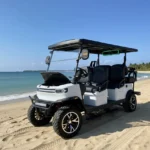
A two-seat buggy is easy to park, economical to operate, and often a strong fit for homeowners, couples, and security patrols. It is also a practical choice when storage space is limited. Four-seat models provide more flexibility for families, homeowners with guests, and resort transportation. If adults will use the rear seat regularly, check legroom, roof coverage, step-in height, and whether all passengers have proper restraints.
Six-seat buggies are useful for larger families, hotel guests, tours, and staff transportation. Their added length affects turning radius, parking, storage, and maneuverability on narrow roads. They can be the right answer for a resort fleet, but they are not automatically the right personal vehicle for every property.
Cargo capacity matters just as much. Grocery runs, beach gear, maintenance tools, towels, luggage, and housekeeping supplies all take up room quickly. A utility-focused vehicle may be more valuable than a passenger model with an attractive body style but little usable storage.
Electric buggies are quiet, simple to operate, and especially popular in neighborhoods, resorts, and golf-oriented communities. They work well when charging is readily available and daily routes fit comfortably within the vehicle’s real-world range. Battery type, charger quality, terrain, passenger load, and accessory use all influence that range.
Gas-powered units can suit remote properties, longer-duty cycles, and operations where quick refueling is more convenient than charging. They may also be useful where charging infrastructure is limited. The trade-off is more engine maintenance, noise, fuel handling, and emissions.
For many buyers, the question is not which powertrain is universally better. It is whether your property has a dependable charging plan, how many miles the vehicle covers each day, and whether the buggy will be used continuously by multiple drivers.
A street-legal vehicle purchase is not complete when the keys change hands. Ask about the documents you will receive and what steps remain before road use. Clear paperwork can prevent delays, registration problems, and confusion over ownership later.
Before committing to a buggy, request clear answers on these five points:
This is especially valuable for buyers purchasing across borders or shipping to an island, resort market, or second home. Vehicle specifications and paperwork should be reviewed before delivery, not after the buggy arrives.
The lowest advertised price can become expensive if it excludes the items needed for your intended use. Compare complete, ready-to-operate quotes rather than comparing base vehicles alone. Ask whether the price includes batteries, charger, lighting package, windshield, mirrors, seat belts, wheels and tires, delivery, setup, and applicable paperwork support.
Service access deserves the same attention. Every vehicle eventually needs tires, brake work, battery service, alignment, replacement keys, accessories, or warranty assistance. A dealer with available parts and trained support can save time when your cart is needed for guests, employees, or everyday transportation.
Commercial buyers should also consider downtime. One inexpensive vehicle may not be the best fleet choice if it cannot be serviced quickly or if parts are difficult to source. Standardizing models across a fleet often makes training, charging, maintenance, and replacement planning easier.
A professional delivery process should include a walk-through of the vehicle’s controls, charging or fueling procedure, safety features, and warranty process. Take the time to inspect fit and finish, verify the seating layout, and confirm that the accessories you ordered are installed.
Pay close attention to the brakes, steering response, tires, lights, turn signals, horn, mirrors, seat belts, windshield, and charging system. Test the buggy with realistic passenger weight when possible. A vehicle that feels responsive with one driver can handle differently with four adults, luggage, or equipment on board.
For electric models, ask how to maintain the batteries during periods when the vehicle will sit unused. This is a common concern for second-home owners and seasonal properties. Proper storage charging can protect battery life and help ensure the buggy is ready when you return.
The right buggy should fit your daily route, your passenger load, and the rules that apply in your community. A knowledgeable dealer can help you compare two-seat, four-seat, six-seat, utility, and fleet options while making the equipment and paperwork requirements easier to understand.
Coyne Carts helps buyers select service-backed vehicles for personal, resort, and commercial use, with inventory and delivery support designed to reduce the usual buying delays. Before you choose a model, bring your planned route, seating needs, and destination requirements to the conversation. That preparation is the simplest way to turn a good-looking buggy into a vehicle you can rely on every day.
[…] golf cart takes up less space and may be simpler to place at the destination than a six-seat street-legal buggy. On the other hand, a larger vehicle may reduce the number of units a resort or property manager […]