

How to Shop Featured Vehicle Inventory Online
October 23, 2026
Shop featured vehicle inventory online with confidence. Compare seating, power, warranties, delivery, and service support before you choose a vehicle.


A resort buggy earns its keep long before a guest steps inside. It has to arrive charged, ride comfortably over the actual roads on your property, look appropriate at the front entrance, and keep moving when housekeeping, maintenance, and guest services all need it at once. The top electric buggies for resorts are not simply the largest or most expensive carts. They are the vehicles that match how your operation moves people, supplies, and staff every day.
For resort owners and fleet managers, the right choice usually comes down to passenger capacity, route length, terrain, charging access, and service support. Buying a fleet that looks good but does not fit the work creates expensive downtime. Buying only utility-focused vehicles can leave premium guests with a less polished arrival experience. The goal is to build a fleet with a clear job for every vehicle.
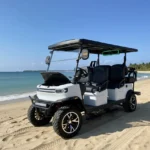
Four-passenger electric buggies are often the most flexible starting point for a resort fleet. They work well for guest shuttles between villas, pools, beach clubs, restaurants, parking areas, and golf facilities. They are compact enough for narrower resort lanes but can still carry a family, a couple with luggage, or an elderly guest who needs a comfortable ride.
Look for forward-facing seating when the vehicle will be used for frequent guest transfers. It creates a more natural, social ride and makes it easier for guests to enter and exit. Rear-facing seating can increase capacity in a shorter footprint, but it may not be the best fit for longer rides or guests carrying bags.
A four-passenger model is also a practical choice for security, concierge, and management teams. Instead of buying a vehicle that sits idle between guest runs, the same buggy can handle light operational work throughout the day.
Six-passenger buggies make sense where distances are longer and groups regularly travel together. Large beachfront resorts, golf communities, event venues, and properties with separate accommodations can reduce the number of trips required by using higher-capacity vehicles.
The trade-off is size. A six-passenger buggy needs more room to turn, park, charge, and navigate service lanes. Before ordering, measure the tightest turns, gate openings, loading areas, and covered parking spots on the property. A vehicle that is ideal for an open golf path may be awkward around compact villa corridors.
For guest-facing use, prioritize comfortable seats, secure handholds, proper lighting, a windshield, and a roof that provides real shade. In sunny coastal markets such as Cabo San Lucas and San Jose del Cabo, shade and ventilation are operational necessities, not cosmetic upgrades.
Guest transportation gets attention, but utility buggies often deliver the strongest daily return. Maintenance teams need cargo space for tools and parts. Housekeeping needs room for linens and cleaning supplies. Landscaping crews may need a vehicle that can travel over uneven surfaces with equipment in the bed.
A utility electric vehicle should be selected around payload, cargo-bed dimensions, ground clearance, and towing needs. Do not assume that every cart with a rear bed is ready for commercial work. A small decorative bed may be fine for towels or bottled water, while a maintenance vehicle may need a reinforced bed, heavier-duty suspension, and a higher payload rating.
If your property has steep grades, loose pathways, or service areas away from guest routes, ask specifically about the vehicle’s ability to handle those conditions under load. Battery range and performance can change considerably when a vehicle is carrying staff, equipment, and supplies uphill.
Some resorts need vehicles that can move beyond private roads. Street-legal low-speed vehicles can be a strong option for connected resort communities, marina areas, nearby beaches, or staff routes where local regulations allow them.
These vehicles typically require equipment such as headlights, taillights, turn signals, mirrors, seat belts, a windshield, and a vehicle identification number. Rules vary by jurisdiction, so street legality is never something to assume based on appearance alone. Confirm where the vehicle will be driven, how it must be registered, and what local speed limits apply before making it part of your transportation plan.
The best electric buggy on paper is not always the best one for your property. A resort fleet should be evaluated as a working system, not as a collection of individual vehicles.
Start with passenger flow. Estimate how many guests need rides during check-in, dinner service, events, and peak beach or pool hours. A fleet with several four-passenger buggies may move guests more efficiently than one oversized unit because vehicles can serve different areas at the same time. On the other hand, a six-passenger buggy can reduce wait times at a remote parking area or group arrival point.
Next, consider your daily route length. Advertised range is a useful reference, but it is not a guarantee under real resort use. Passenger weight, hills, stop-and-go driving, tire pressure, climate, and accessory use all affect battery performance. Plan for a buffer rather than running every vehicle close to empty at the end of a shift.
Charging is equally important. A dependable vehicle can still become a problem if the charging area is inconvenient, undersized, or poorly managed. Centralized charging works well for fleets that return to one service area overnight. Properties with split operations may need charging access near villas, maintenance areas, or staff facilities. Your electrical setup should be reviewed before the fleet arrives, not after.
Lead-acid and lithium battery systems can both serve resort fleets, but they suit different priorities. Lead-acid batteries usually cost less upfront and are familiar to many service teams. They also require more routine care and can be less efficient for demanding daily cycles.
Lithium systems generally offer longer usable range, faster charging, lower vehicle weight, and less maintenance. Their higher initial cost can make sense for high-utilization fleets, especially where vehicle availability directly affects guest service. The right decision depends on hours of use, charging windows, budget, and how long you plan to keep the fleet.
Battery type should not be the only service consideration. Ask about brake components, suspension parts, tires, onboard chargers, body panels, and the availability of trained technicians. Resorts cannot afford to park a vehicle for weeks over a basic part. A supplier with inventory access, warranty support, and a clear parts process can be more valuable than a lower purchase price without follow-through.
Not every accessory adds value, but a few options directly improve operations and guest satisfaction. Windshields, rain enclosures, upgraded seats, seat belts, LED lighting, mirrors, and reliable tires are worthwhile on vehicles used for guest transportation. For utility units, focus spending on cargo capability, protective bumpers, tool storage, stronger suspension, and tires suited to the surface conditions.
Fleet appearance matters as well. A clean, consistent color package and professional branding make transportation feel like part of the resort experience. However, custom finishes should come after the basics: correct capacity, appropriate battery system, dependable braking, and serviceability.
It is also smart to standardize where possible. Using a smaller number of vehicle platforms can simplify driver training, parts inventory, charging procedures, and maintenance. A mixed fleet is often necessary, but it should be intentionally mixed. For example, guest shuttles, utility buggies, and street-legal vehicles may each have a role without creating unnecessary complexity.
Resort transportation needs change with occupancy, expansion, new amenities, and seasonal demand. Before placing an order, consider whether the fleet needs room to grow. A dealer that can provide multiple passenger configurations, utility vehicles, parts, warranty assistance, and delivery coordination gives your operation a more practical path as demand increases.
Coyne Carts works with resort and commercial buyers who need more than a single cart purchase, including fleet planning, broad vehicle availability, and after-sale support across Baja California Sur and beyond. That support is especially valuable when you need to replace a vehicle quickly or add units ahead of a busy season.
The right buggy fleet should feel almost invisible to guests: rides arrive when needed, staff have the equipment to do their work, and vehicles stay out of the shop. Choose capacity and features based on your daily operations, then invest in service support that keeps the fleet ready when your property is busiest.