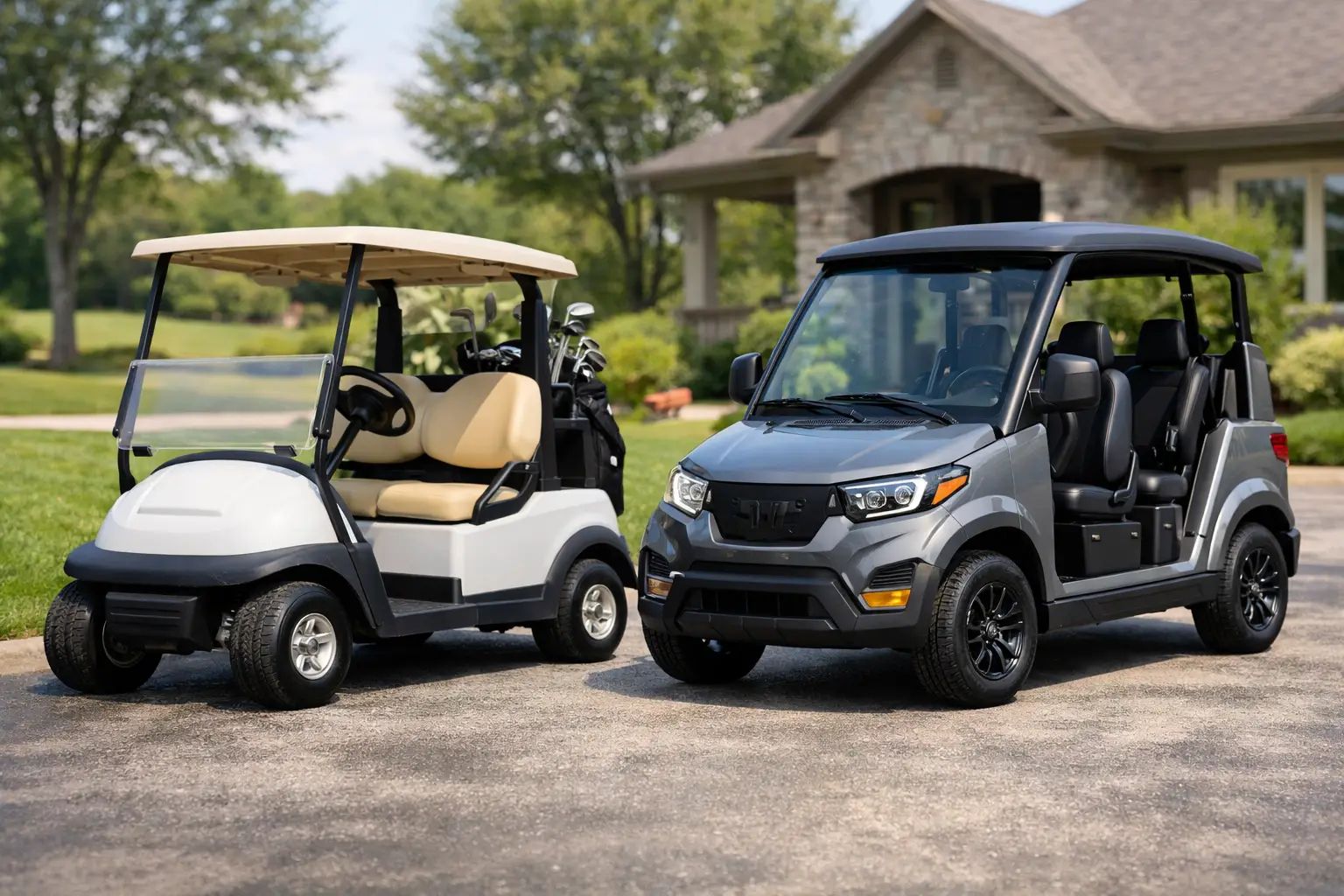
A golf cart vs LSV decision often comes down to one question: will the vehicle stay on private property, or does it need to travel legally on public roads? The two can look similar, especially in a resort community or coastal neighborhood, but their intended use, equipment, paperwork, and operating rules are very different.
For homeowners, resorts, rental companies, golf courses, and service fleets, choosing the wrong vehicle can create unnecessary expense or limit where it can be used. The right choice starts with the routes your drivers will actually take, not simply the number of seats or the color of the body.
What Is a Golf Cart?
A traditional golf cart is built primarily for golf courses, private communities, resorts, campuses, and private land. It is made for low-speed transportation over relatively short distances. Most golf carts carry two, four, or six passengers, although utility configurations are also common for maintenance and hospitality work.
Golf carts are practical because they are simple, compact, and cost-effective. They can move guests around a resort, carry players and clubs across a course, or make everyday trips around a large residential property without the size and fuel cost of a full vehicle.
However, a standard golf cart is not automatically street legal. It may not include the federally required safety equipment, vehicle identification number, registration capability, or manufacturer certification needed for road use. Adding accessories such as mirrors, lights, or a horn does not necessarily turn a standard cart into a legally recognized road vehicle.
That does not make a golf cart the lesser choice. If it will remain on private roads, resort grounds, a golf course, or a gated property where local rules allow it, a golf cart may be exactly what you need. There is no reason to pay for road certification and equipment if your operation will never use public streets.
What Is an LSV?
An LSV, or low-speed vehicle, is a four-wheeled motor vehicle designed and manufactured for limited public-road operation. In the United States, an LSV is generally capable of speeds above 20 mph but no more than 25 mph, with a gross vehicle weight rating under 3,000 pounds. It is also required to meet specific federal safety standards.
Those standards typically include headlights, taillights, brake lights, turn signals, reflectors, exterior mirrors, a windshield, windshield wipers, seat belts, a parking brake, and a vehicle identification number. An LSV is commonly equipped for registration and insurance where local law permits it.
The term “street legal” is often used loosely in the cart market. A true LSV is not simply a golf cart with aftermarket lights. It is a vehicle built and documented to meet the applicable low-speed vehicle standards. That distinction matters when you need to register it, insure it, operate it in a regulated community, or place it into a commercial rental fleet.
LSVs are typically permitted only on roads with lower posted speed limits, often 35 mph or less in U.S. jurisdictions. The exact rules vary by state, county, city, homeowner association, and resort property. In Mexico and other international markets, road access, registration, and operating requirements can also vary by local authority. Always verify the rules for the exact area and routes you plan to use before buying.
Golf Cart vs LSV: The Practical Differences
The biggest difference is where the vehicle is intended to operate. A golf cart is usually the better fit for controlled private property. An LSV is the better starting point when you need a properly equipped vehicle for eligible public roads, subject to local registration and access rules.
Speed is another important distinction. Traditional golf carts are commonly set up for lower operating speeds, often around 12 to 15 mph. LSVs are designed to reach up to 25 mph. That extra speed can make a real difference when staff are moving between resort buildings, homeowners are traveling through a community, or a rental customer needs to reach nearby approved destinations.
Equipment and cost follow from that difference. An LSV generally costs more because it includes required road equipment, documentation, and engineering. It may also involve registration, insurance, licensing requirements, and more paperwork. A standard golf cart can be more economical to purchase and maintain when road operation is not part of the plan.
Neither one should be chosen based on appearance alone. A lifted six-passenger cart with premium wheels may be ideal for a beach property, but it may still be limited to private use. A more modest-looking LSV may be the better business decision if it must operate on approved neighborhood streets and meet local fleet requirements.
Which Vehicle Works Best for Your Use?
For golf courses, a traditional golf cart remains the natural choice. It is purpose-built for moving players, guests, bags, beverages, and maintenance equipment across course grounds. Course operators often benefit from having several body styles in the same fleet, including two-passenger units, four-passenger guest carts, utility carts, and specialty vehicles for staff.
For resorts and hospitality properties, the answer depends on the size of the property and whether guest transportation crosses public roads. A golf cart may be enough for internal transportation between villas, pools, restaurants, and beach access points. An LSV can make more sense for approved road routes connecting separate facilities or operating within a community that requires street-legal vehicles.
For homeowners and second-home owners, consider your daily routine. If the cart is for traveling around a private neighborhood, marina, large lot, or golf course community, a golf cart may be the simplest and most affordable option. If you expect to use it for local errands on roads where LSVs are allowed, an LSV gives you a more appropriate platform to register and operate legally.
For commercial fleets, it is smart to think beyond the first purchase price. A resort, rental operator, or property management company needs vehicles that match its permitted routes, passenger capacity, charging setup, maintenance plan, and insurance requirements. Buying a lower-cost cart that cannot serve a needed route can cost more over time than selecting the right LSV from the beginning.
Battery Choice Matters, Too
Whether you choose a golf cart or an LSV, battery technology affects daily ownership. Lead-acid batteries remain a dependable, familiar option and can be a practical fit for many applications. They require regular watering, cleaning, and charging discipline, especially in warm coastal climates.
Lithium batteries usually cost more upfront but offer faster charging, reduced maintenance, lighter weight, and consistent performance throughout the charge cycle. For high-use resort fleets, rentals, and customers who want less maintenance, lithium can be worth the investment. For occasional use on a private property, the right lead-acid setup may still provide excellent value.
Range should be evaluated honestly. Passenger count, terrain, tire selection, cargo, air temperature, and driving habits all affect how far a vehicle will go between charges. A four-passenger LSV carrying guests up hills all day will consume battery capacity much faster than a two-passenger cart used for short, flat trips.
Questions to Ask Before You Buy
Before choosing a golf cart or LSV, confirm where the vehicle will operate and whether those roads are private or public. Ask the local authority, community management team, or property operator about speed limits, registration, driver licensing, insurance, and any restrictions on passenger seating or nighttime operation.
Then match the vehicle to the job. Consider how many people need to ride, whether you need a rear-facing seat or cargo bed, how often it will run each day, and where it will charge. A rental fleet may prioritize durable seating, easy charging, and consistent vehicle availability. A homeowner may value comfort, storage, and a premium finish. A maintenance team may need utility capacity more than passenger seating.
Finally, ask about parts, warranty coverage, and service support before committing. A vehicle is only a good value if you can keep it working. This is especially relevant for buyers in Cabo San Lucas, San Jose del Cabo, La Paz, Loreto, Los Barriles, and other destination markets where vehicle uptime directly affects guest service and property operations.
The Better Choice Is the One That Fits the Route
A golf cart is often the smart, economical answer for private-property transportation. An LSV is the better option when approved public-road travel, registration capability, and road-required equipment are part of the plan. Coyne Carts can help buyers compare available configurations, passenger capacities, battery options, and service support so the vehicle you select works as hard as you need it to from day one.
Before you choose, map the routes, confirm the local rules, and buy for the use you will have next year as well as the use you have today.